
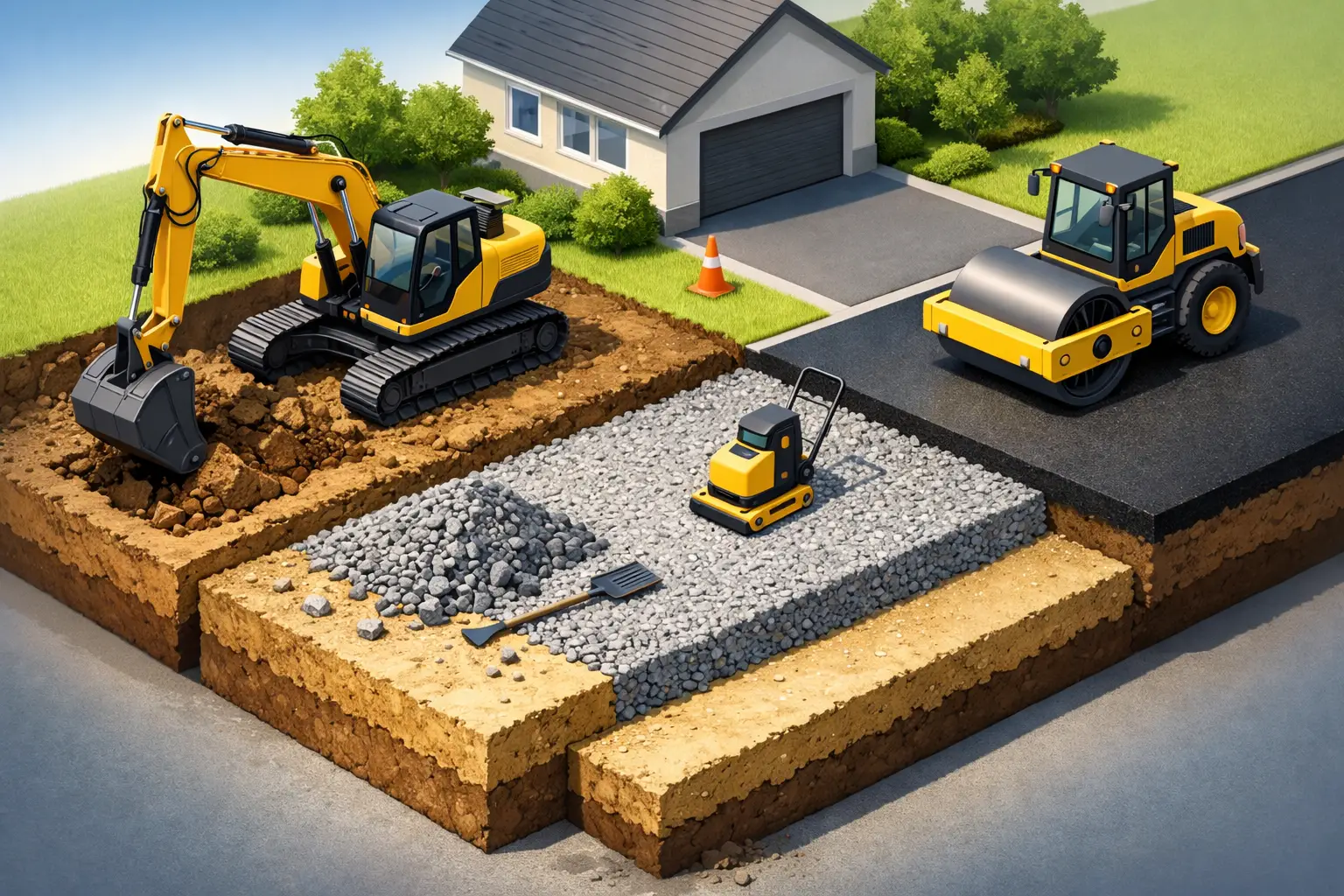
A new asphalt driveway can look great on installation day and still fail far sooner than it should if the ground beneath it was rushed. Cracks, low spots, standing water, and sinking edges often start below the pavement, not on top of it. Knowing how to prepare driveway subgrade helps you understand what a quality paving job should include and why proper prep is worth the time.
The subgrade is the natural soil or existing ground under the driveway base. It must be shaped, stable, and able to drain before stone base and asphalt are installed. On Long Island, where soils, groundwater, shade, and seasonal weather can vary from one property to the next, there is no one-size-fits-all depth or method. The goal is always the same: build a firm, dry foundation that supports traffic without moving.
Why driveway subgrade preparation matters
Asphalt is flexible, but it is not a cure for weak soil. When the subgrade softens after rain or shifts under vehicle weight, the base above it moves too. That movement eventually shows up as alligator cracking, dips near garage entrances, puddles, and broken driveway edges.
A properly prepared subgrade does three jobs. It supports the weight of cars and trucks, keeps the driveway pitched so water moves away, and gives the crushed-stone base a uniform surface to rest on. Skipping any of those steps can turn a straightforward paving project into a repair job.
This is especially important for driveways that handle heavier vehicles. A household with two sedans puts different demands on a driveway than a property with delivery vans, work trucks, or frequent garbage truck traffic near the apron. The soil conditions and expected use should guide the preparation plan.
How to prepare driveway subgrade step by step
Start with the finished height and drainage plan
Before excavation begins, determine where the finished asphalt surface needs to sit. The driveway should meet garage floors, walkways, curbs, and existing pavement cleanly without trapping water against a building.
A driveway needs a controlled slope that directs water toward a safe drainage area, not toward the house, garage, or neighboring property. The exact pitch depends on the site, but the surface should have a consistent fall rather than random high and low areas. A level-looking driveway can still drain correctly when it is graded carefully.
This stage is also the time to identify trouble spots. If water already collects near the garage, along one side of the driveway, or at the street, simply paving over that area will not solve the underlying issue. It may require regrading, drainage improvements, or a different approach at the low point.
Remove old pavement, loose material, and organic soil
For a replacement driveway, old asphalt should be removed along with failed base material underneath it. Leaving soft, broken layers in place can allow problems to continue under the new surface. Reclaimed asphalt may be reusable in some situations, but only when it is processed and incorporated correctly into a stable base plan.
Next, excavate to the required depth for the stone base and asphalt while accounting for the final grade. Remove roots, grass, topsoil, mulch, and other organic material. Organic soils decompose and compress over time, which creates voids under the driveway.
Do not judge the excavation solely by depth. The bottom of the excavation should be firm and evenly shaped. If an area pumps, feels spongy under equipment, or holds water, it needs more attention before base stone goes down.
Inspect the soil for soft or wet areas
Not all soil can carry a driveway base without improvement. Dense, well-draining material may need only grading and compaction. Clay-heavy soils, saturated ground, old fill, and areas disturbed by utility work can require undercutting and replacement with suitable aggregate.
Soft spots should not be covered with extra asphalt. Asphalt is a finish layer, not structural repair material. Depending on the conditions, a contractor may remove weak soil, install a separation fabric, add larger clean stone for drainage, or use a thicker crushed-stone base. The right answer depends on how deep the weak area goes and whether groundwater is involved.
Separation fabric can be useful where soft soil and stone would otherwise mix together. It helps keep the aggregate base from being swallowed by the soil below. It is not needed on every driveway, and it will not fix severely unstable ground by itself, but it can be a smart part of the system in the right conditions.
Shape the subgrade before placing stone
Once unsuitable material is removed, the soil subgrade should be graded to match the driveway’s intended drainage direction. This creates an even platform for the aggregate base. A smooth subgrade does not mean perfectly flat. It means consistent, properly pitched, and free of abrupt pockets that can trap water.
Pay close attention to driveway edges. Edges often fail first because they receive less support and may be exposed to lawn irrigation, runoff, or vehicle tires cutting too close. The prepared area should extend far enough beyond the finished driveway width to fully support the asphalt and base.
If the driveway connects to a public street, the transition at the apron must also be planned carefully. Water should not be directed into the roadway in a way that creates a hazard, and the new work may need to follow local requirements.
Compact the subgrade when conditions are right
Compaction gives the soil the strength to support the layers above it. A contractor typically uses heavy equipment suited to the soil and access conditions. The goal is a firm, uniform surface, not simply driving a machine over the ground once.
Moisture matters. Soil that is too dry may not compact well, while saturated soil can rut and pump under a roller. After extended rain, it is often better to wait than to force equipment across wet ground. Paving on a rushed schedule can be costly if the subgrade is damaged before the base is even installed.
Compaction is also why preparation should not be treated as an invisible shortcut. A driveway may be paved quickly, but proper excavation, grading, drying, and compacting take the time the site requires.
Build the stone base in compacted lifts
After the subgrade is approved, crushed aggregate is installed as the structural base. The thickness should suit the soil and expected traffic. A light residential driveway on stable soil may need less base than a commercial lot entrance, a long driveway used by work vehicles, or a site with poor drainage.
The stone should be placed in manageable layers, often called lifts, and compacted thoroughly before the next layer is added. Installing a deep layer all at once makes it harder to compact the full depth evenly. The upper surface of the base should maintain the intended slope and be checked for soft spots before asphalt is placed.
This is where an experienced paving crew earns its value. The base needs enough depth, the right material, and solid compaction, but it also needs to stay within the planned finished elevation. Too much stone can create height problems at a garage or walkway. Too little leaves the asphalt without enough support.
Avoid the shortcuts that cause early driveway failure
A few common mistakes lead to expensive problems later. Paving over wet or soft soil is one. Another is using asphalt thickness to make up for inadequate base work. Asphalt can provide a clean, durable driving surface, but it cannot bridge unstable ground forever.
Poor drainage is another major issue. Water that sits under the driveway weakens the soil and base, especially through freeze-thaw cycles. Even in areas with relatively mild winters, repeated moisture and traffic can slowly break down a poorly prepared foundation.
It also helps to be realistic about driveway use. If a dumpster truck, moving truck, contractor trailer, or commercial vehicle will routinely use the surface, mention that before work starts. Planning for actual traffic is more affordable than repairing damage after the fact.
When professional preparation is the better choice
Homeowners can handle small grading tasks, but full driveway subgrade work usually requires excavation equipment, compaction equipment, material hauling, and experience reading site conditions. The project becomes more complex when there are drainage concerns, utility lines, retaining walls, tight access, or major elevation changes.
A dependable contractor should explain what is being removed, how the base will be built, where water will drain, and whether the soil needs extra treatment. Clear answers upfront help prevent surprises and make it easier to compare estimates fairly.
For Long Island property owners, Big Apple Paving and Remodeling takes the time to assess the ground beneath the driveway, not just the asphalt you will see at the end. A driveway built on a properly prepared subgrade gives your property a stronger starting point and gives you more confidence every time you pull in.